
Active Users in Airbridge
Airbridge determines an active user as a unique user that performed one or more app or web event within the set date range. A unique user is a user that is identified to be unique by the identifier Airbridge uses for attribution.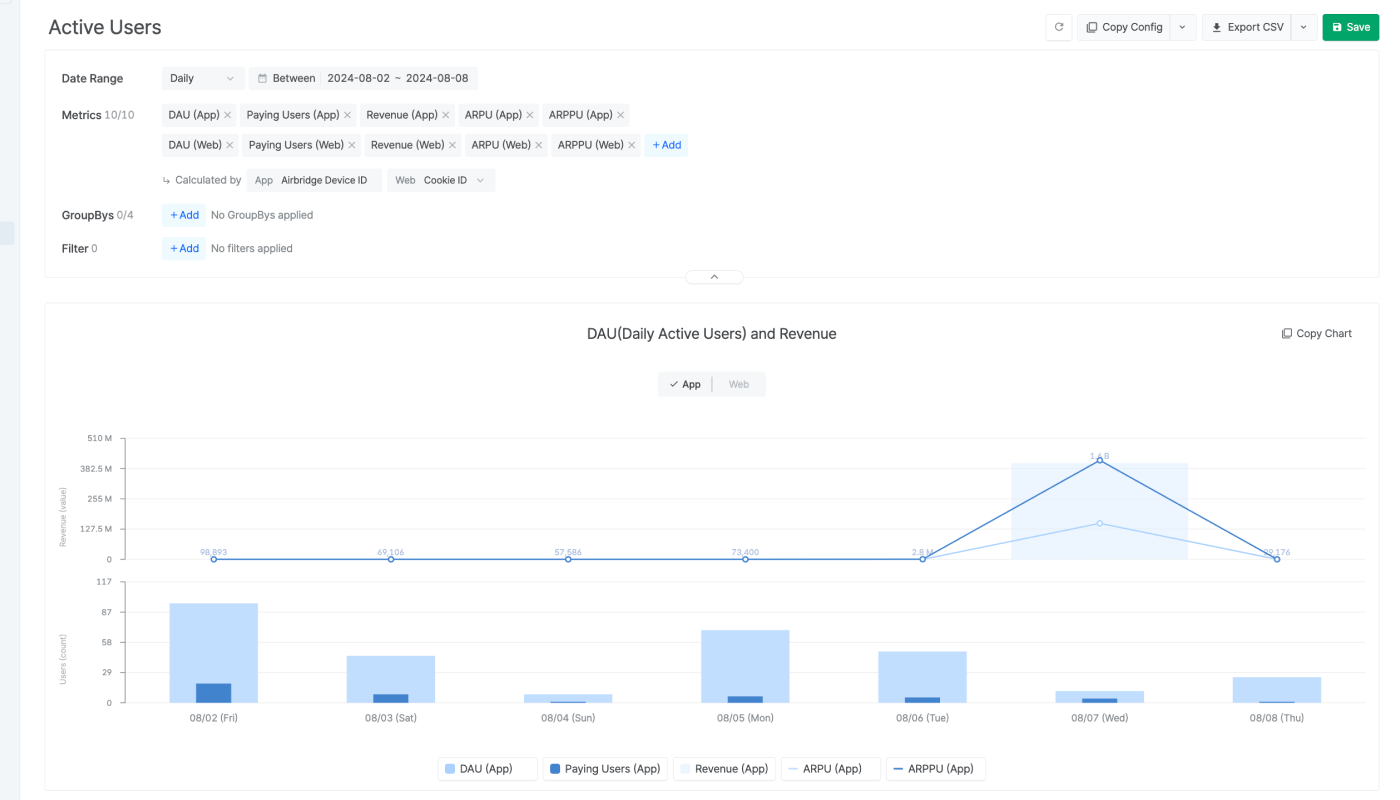
Unique UsersThe number of unique users is different from the number of events. Even though an event occurred 10 times during the set date range, the number of unique users is counted as 1 if all 10 events were performed by a single user. For more details on the identifiers used for determining unique users by reports, refer to this article.
Configuring a Report View
The configuration box offers options for configuring the granularity, date range, metrics, GroupBy, and filter to create a customized report view that suits your needs.Granularity and date range
Configure the granularity and date range to create a report view.Granularity
The Active Users Report shows data by the set granularity. The granularity options includeDaily, Weekly, and Monthly.
- Daily: 24 hours based on the configured Airbridge App timezone
- Weekly: Maximum 7 days based on the set start of week
- Monthly: Maximum 1 month
Data display by granularity
Data display by granularity
Let’s say the date range was set as follows.
- Date range: From January 30 (Fri) to February 10 (Tue)
Data display examples for Weekly and Monthly view
Data display examples for Weekly and Monthly view
Refer to the examples below to understand how data is displayed when selecting 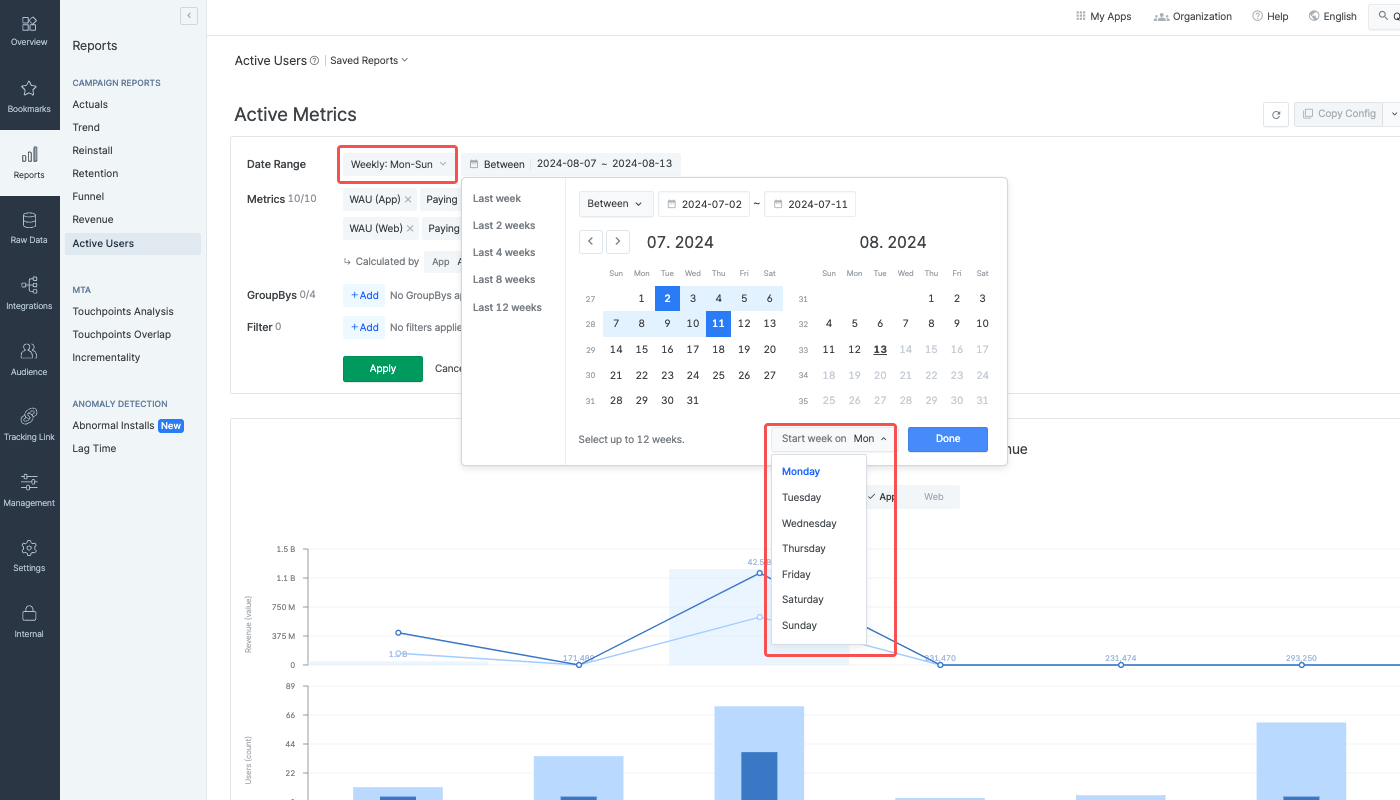
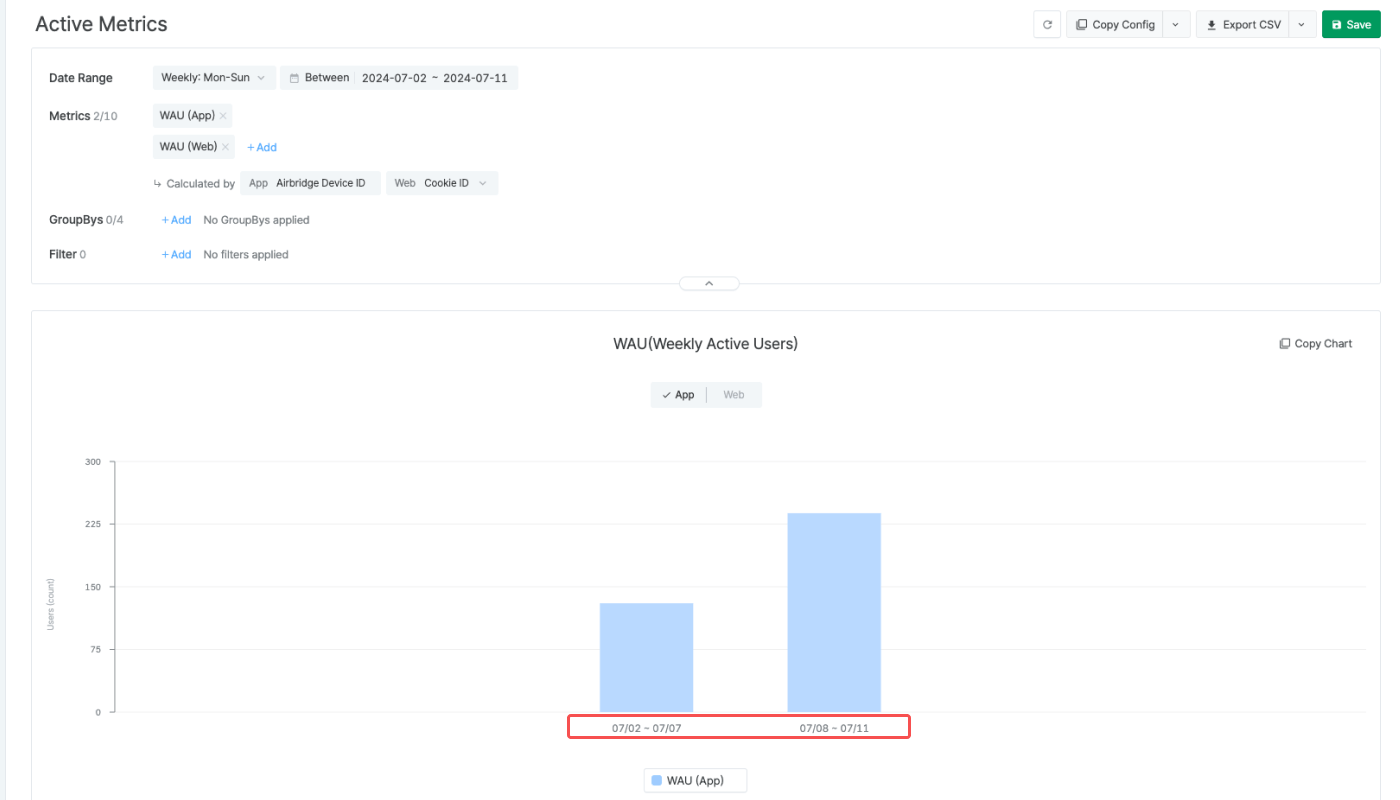
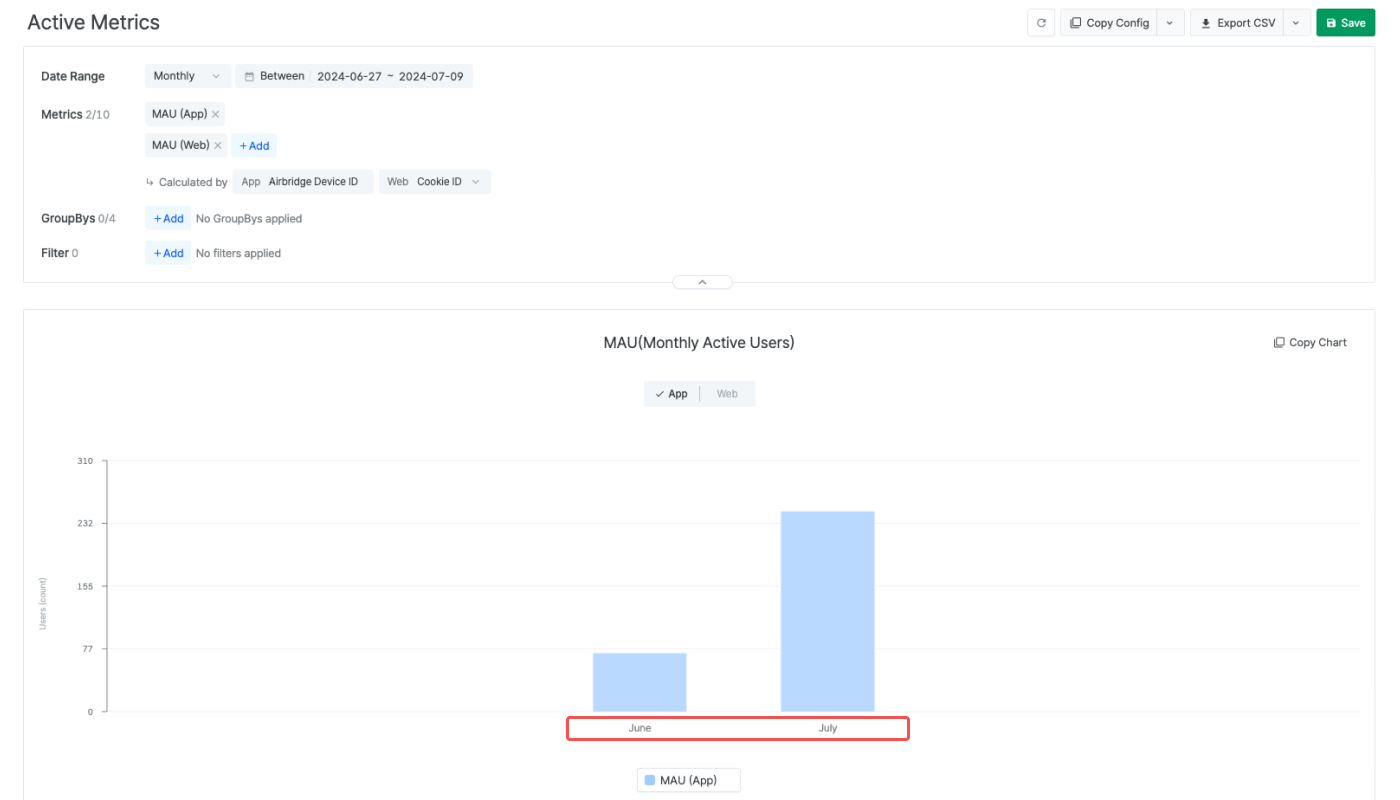
Weekly or Monthly for granularity.Weekly
Let’s say the report settings have been configured as follows.- Granularity: Weekly
- Start of the week: Monday
- Date range: From 2024-07-02 (Tue) to 2024-07-11 (Thu)
Monthly
- Granularity: Monthly
- Date range: From 2024-06-27 (Thu) to 2024-07-09 (Tue)
Available metrics differ depending on the granularity settings
Available metrics differ depending on the granularity settings
Depending on the granularity settings, you can select the DAU, WAU, or MAU as a metric. For example, when setting the granularity to 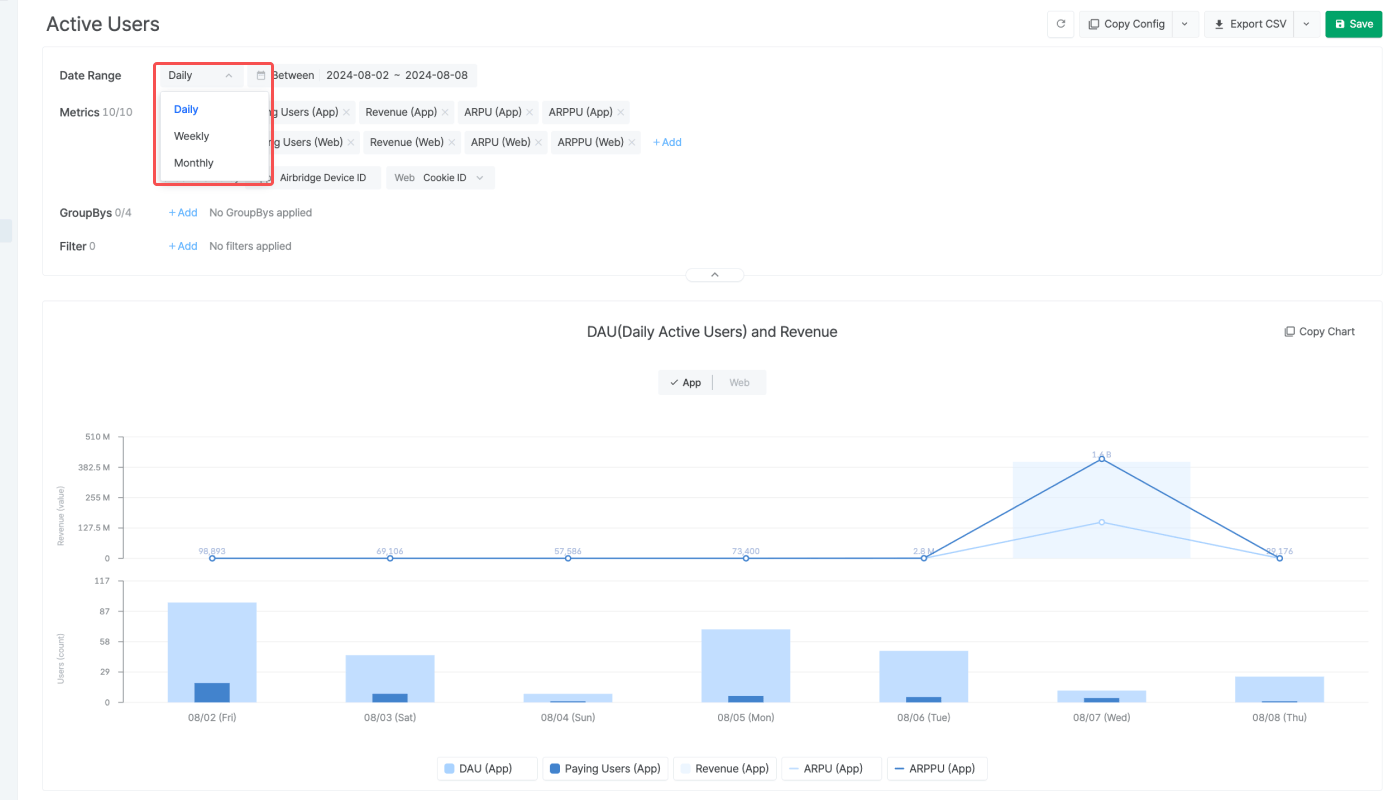
Monthly, you can select the MAU as a metric to create a report view.Date range
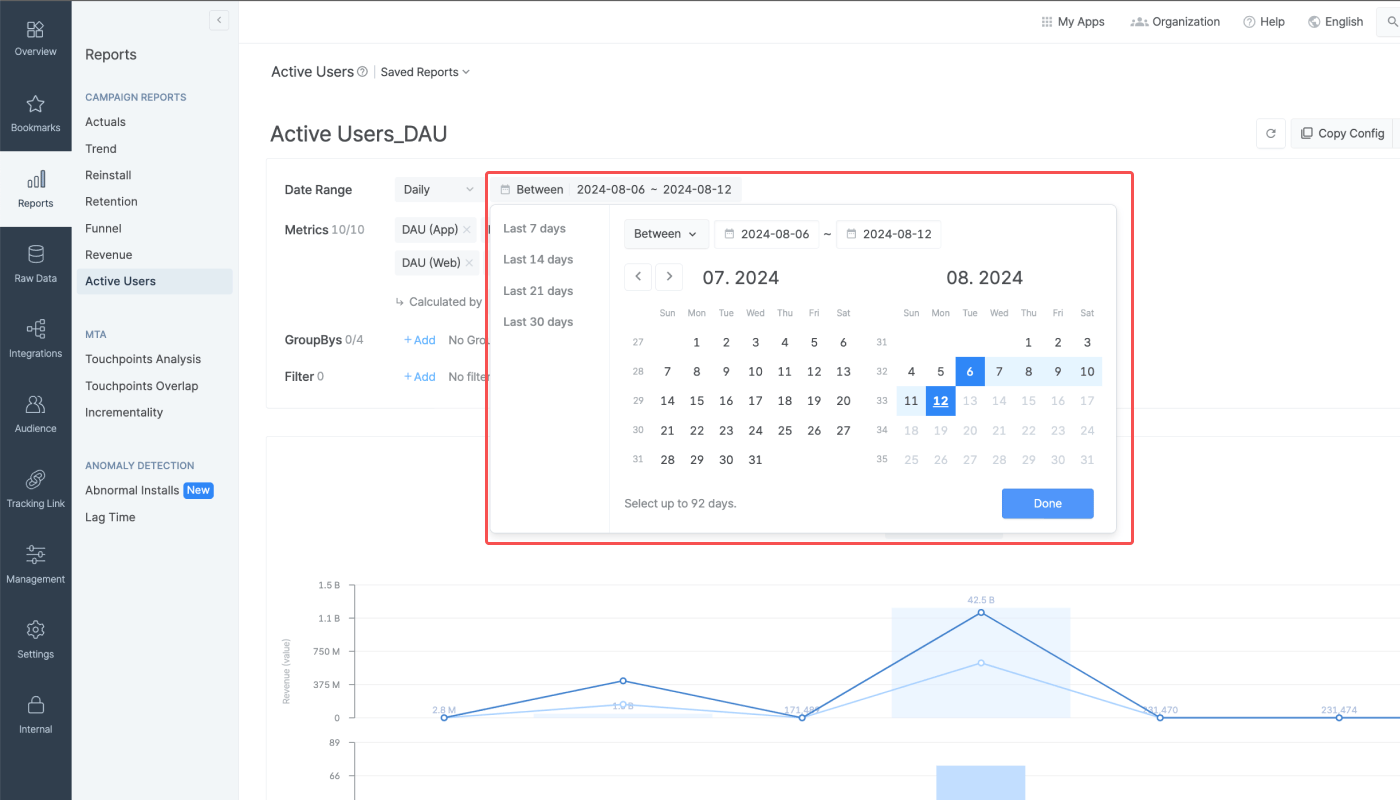
Set the date range to create a report view that shows the metric data of the user who performed any event within a specific time period. Up to 175 days can be selected, including today. Depending on the set granularity, the maximum date range you can configure differs.- Daily: Select up to 31 days.
- Weekly: Select up to 12 weeks.
- Monthly: Select up to 3 months.
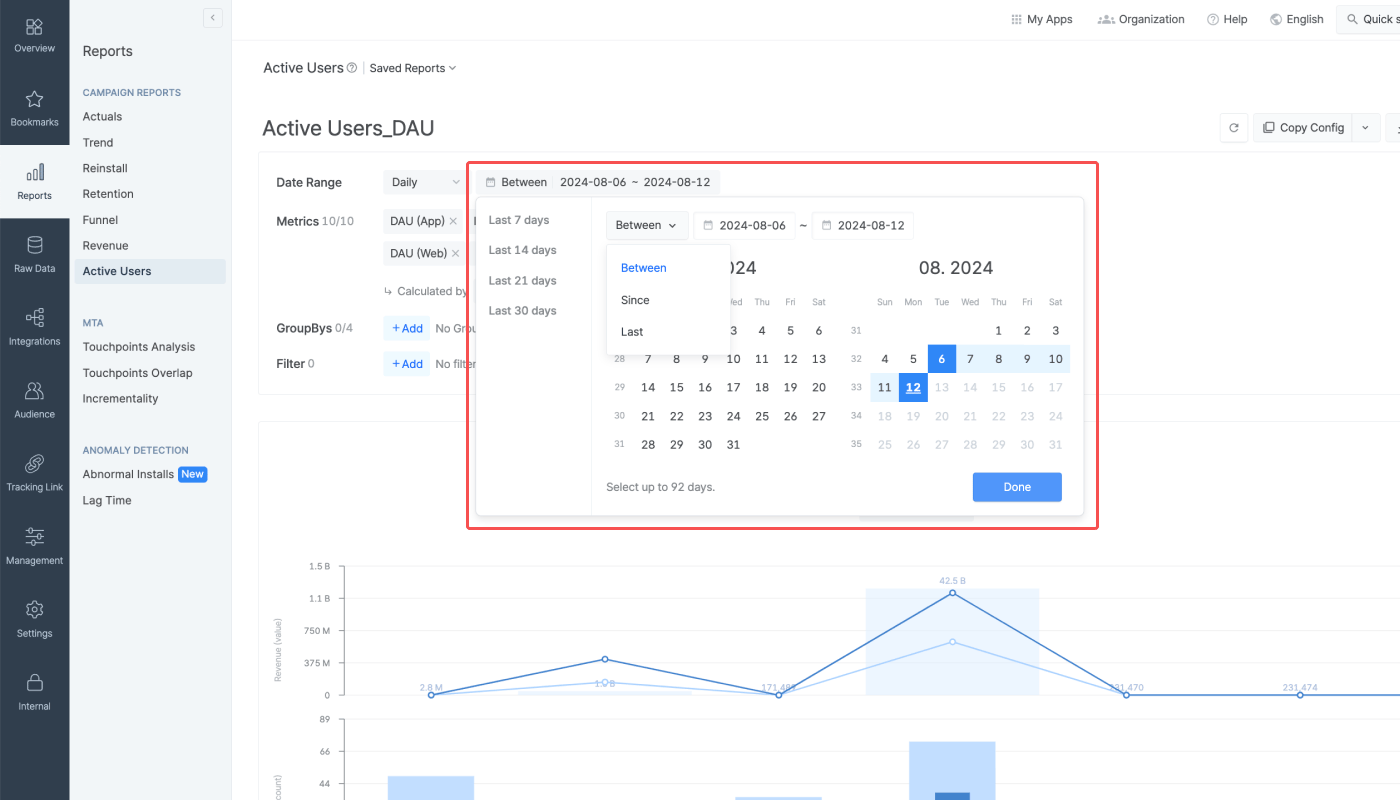
Date range settings
Date range settings
The date range can be set using the following conditions.
When using “Last,” options such as “Include today,” “Include this month,” and “Offset” can be added.For example, if you select Last 30 days and add Offset + 3 days, the date range will start 33 days before today and end 4 days before today.
Metrics and Calculated by
The following metrics are available in the Active Users Report. Both app and web metrics can be visualized in the report at the same time.Metrics available in the Active Users Report
Metrics available in the Active Users Report
Both app and web metrics are available in the Active Users Report. App metrics are suffixed with (App) and web metrics are suffixed with (Web).The DAU, WAU, and MAU are available as a metric depending on the selected granularity. For example, if the granularity is set to Daily, DAU is available as a metric. If the granularity is set to Monthly, MAU is available as a metric.
Users that are not aggregated as Active UsersThe following users are not aggregated as Active Users, and are not included in the DAU, WAU, and MAU metric data.
- Users who didn’t launch the app
- Users who deleted the app
Daily, the user who launched your app on January 1 is aggregated as an Active User and is included in the DAU. If this user does not launch the app on the next day and deletes the app, the user won’t be included in the DAU of January 2.Identifier used to aggregate unique app users
Identifier used to aggregate unique app users
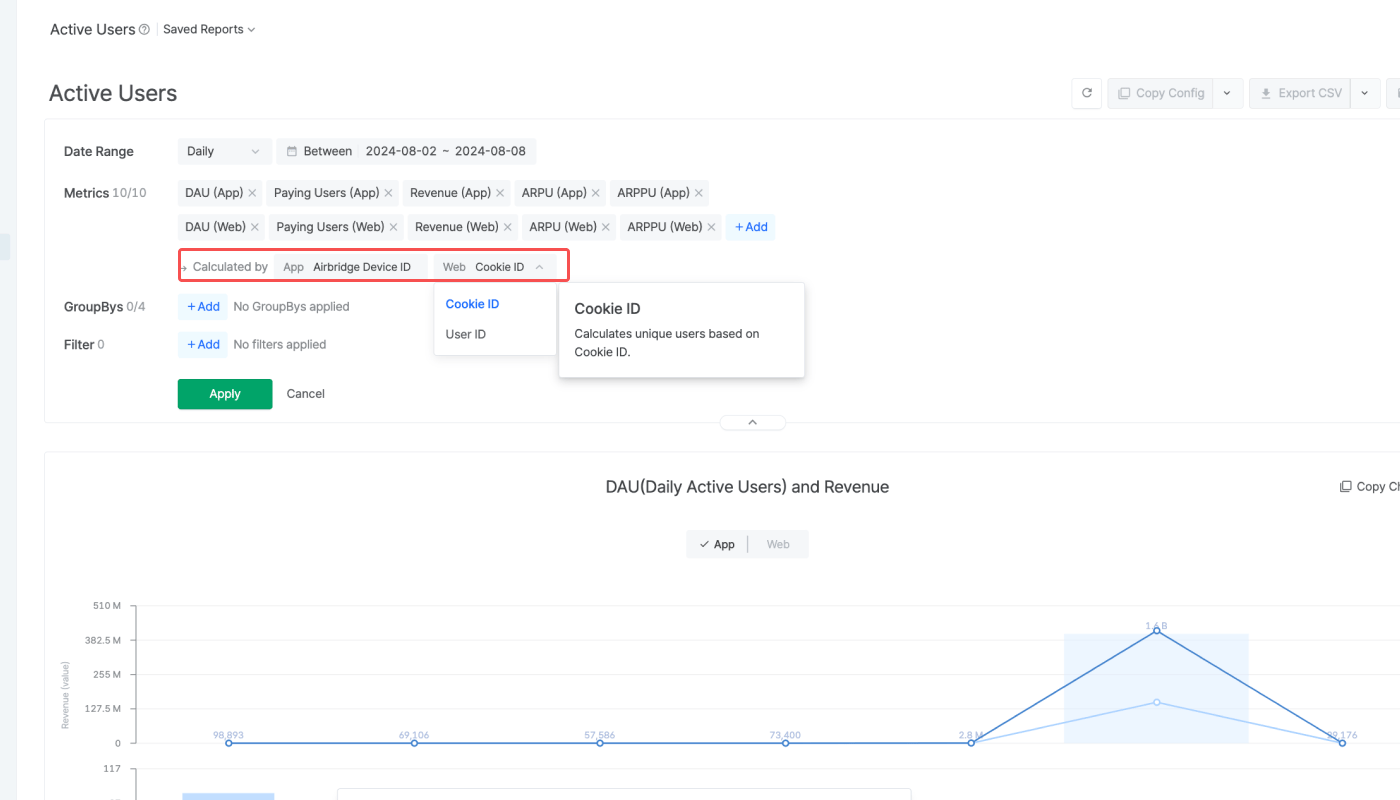
Airbridge Device ID (User Count) is used to determine unique app users. Airbridge Device ID (User Count) is the most suitable of GAID and App Set ID on Android, or IDFA and IDFV on iOS. When none is available, Airbridge uses a randomly generated ID.
Identifier used to aggregate unique web users
Identifier used to aggregate unique web users
Cookie IDs or user IDs are used to determine unque users who performed web events. Cookie ID is a type of device IDs.
- Cookie ID: Airbridge aggregates all users who entered the service regardless of whether the user logged in to your service or not
- User ID: Airbridge aggregates unique users based on the login information of your service. The
user.externalUserIDattribute must be set in the Airbridge Web SDK to send User IDs to Airbridge. For more details, refer to the developer guide.
AttentionThe Revenue (Web) data aggregated based on the unique users determined by User IDs in the Active Users Report may be different from the Revenue (Web) data in the Actuals Report and Trend Report. This is because the Active Users Report does not aggregate the revenue generated by users who are not identifiable by User IDs.
GroupBy and filter
AttentionThe GroupBy and filter settings apply to the charts and table as follows.
- GroupBy settings: Applies to the table only
- Filter settings: Applies to both the charts and table
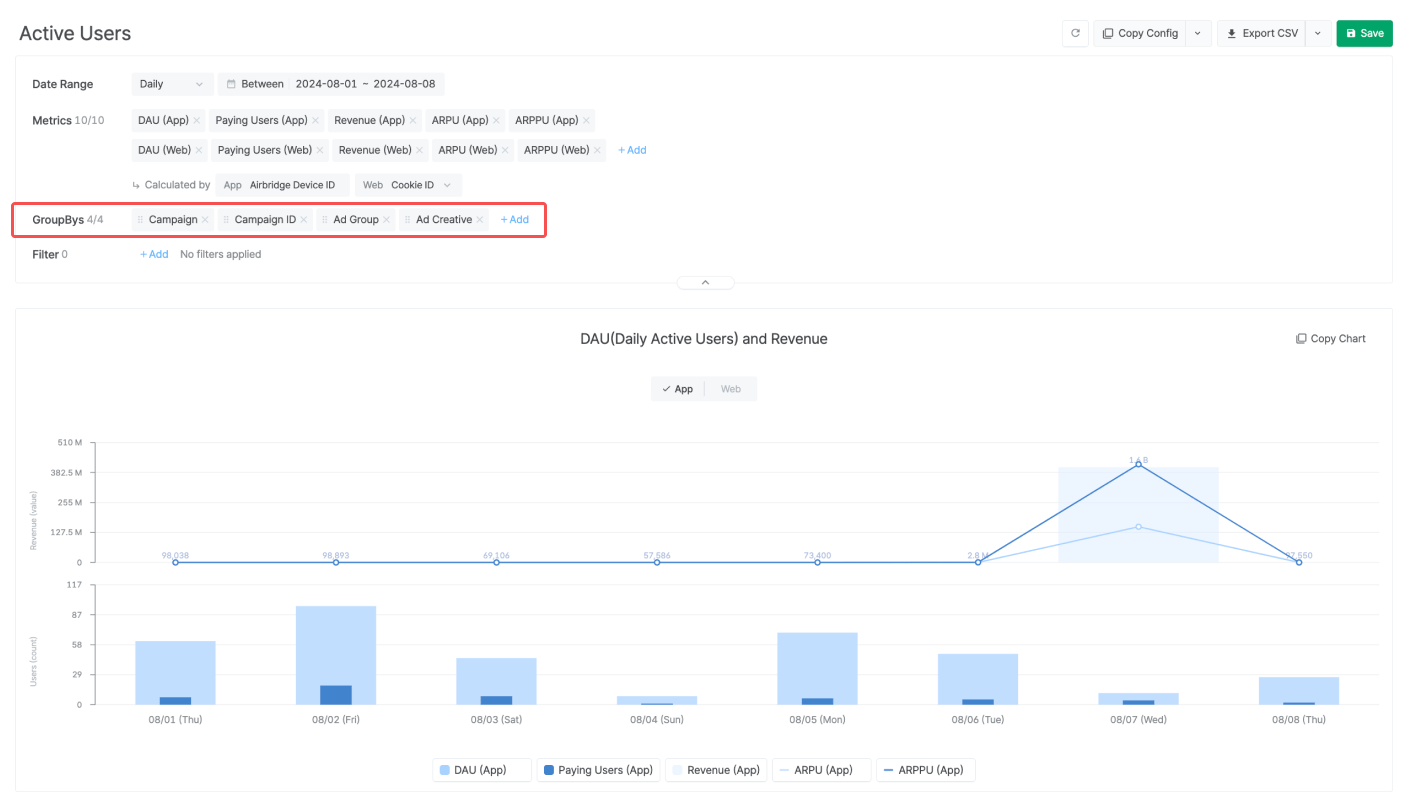
Understanding the Active Users Report
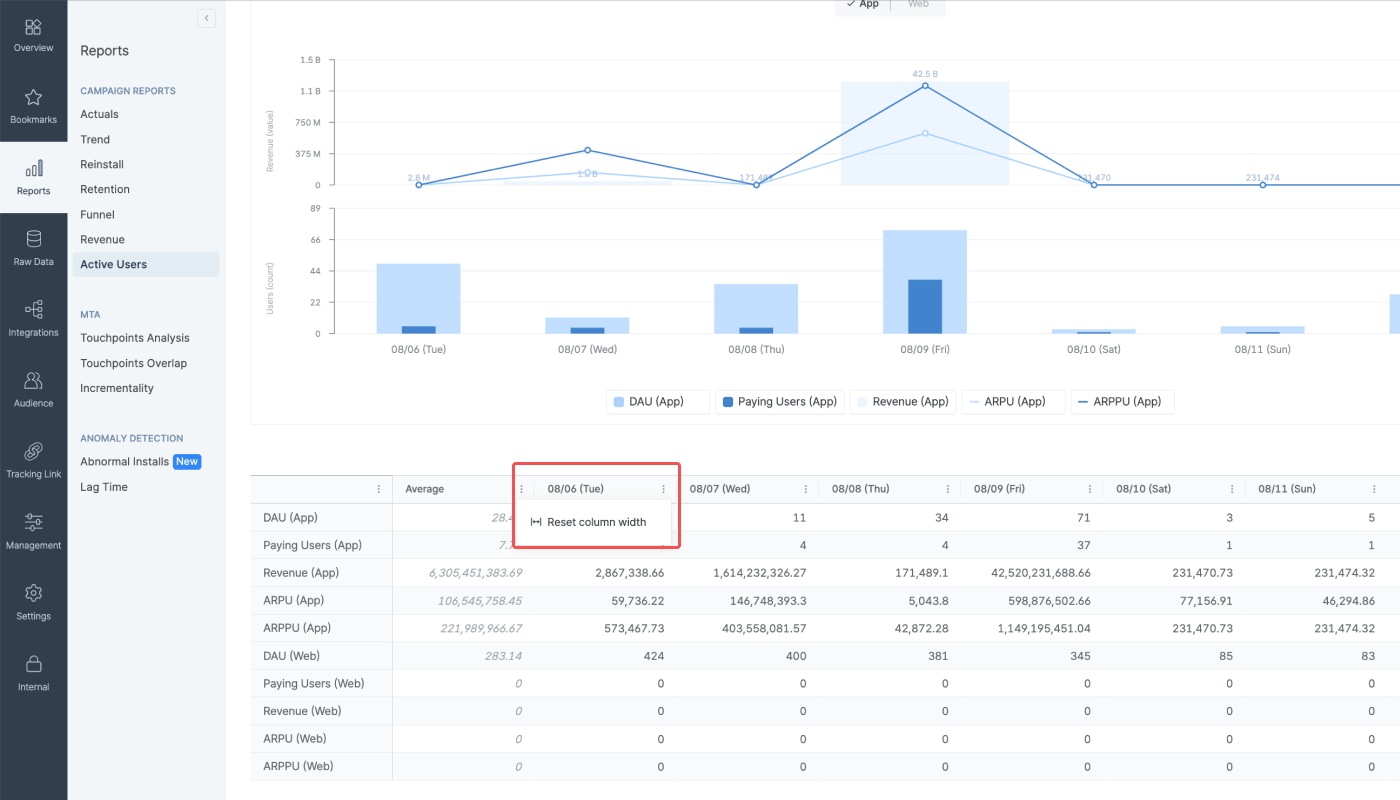
The Active Users Report visualizes the metric data at the chosen granularity in 2 charts and a table.NoteStarting February 4, 2025, the Overview Dashboard, Actuals Report, Trend Report, Retention Report, Revenue Report, Active Users Report, and Audience Manager will only display events and metrics measurable using the collected data.
Chart
The Active Users Report provides a bar chart and a line chart to display different metrics. Hover over the chart to view the data points in numbers.- DAU, WAU, MAU, Paying Users, Revenue: Bar chart
- ARPU, ARPPU: Line chart
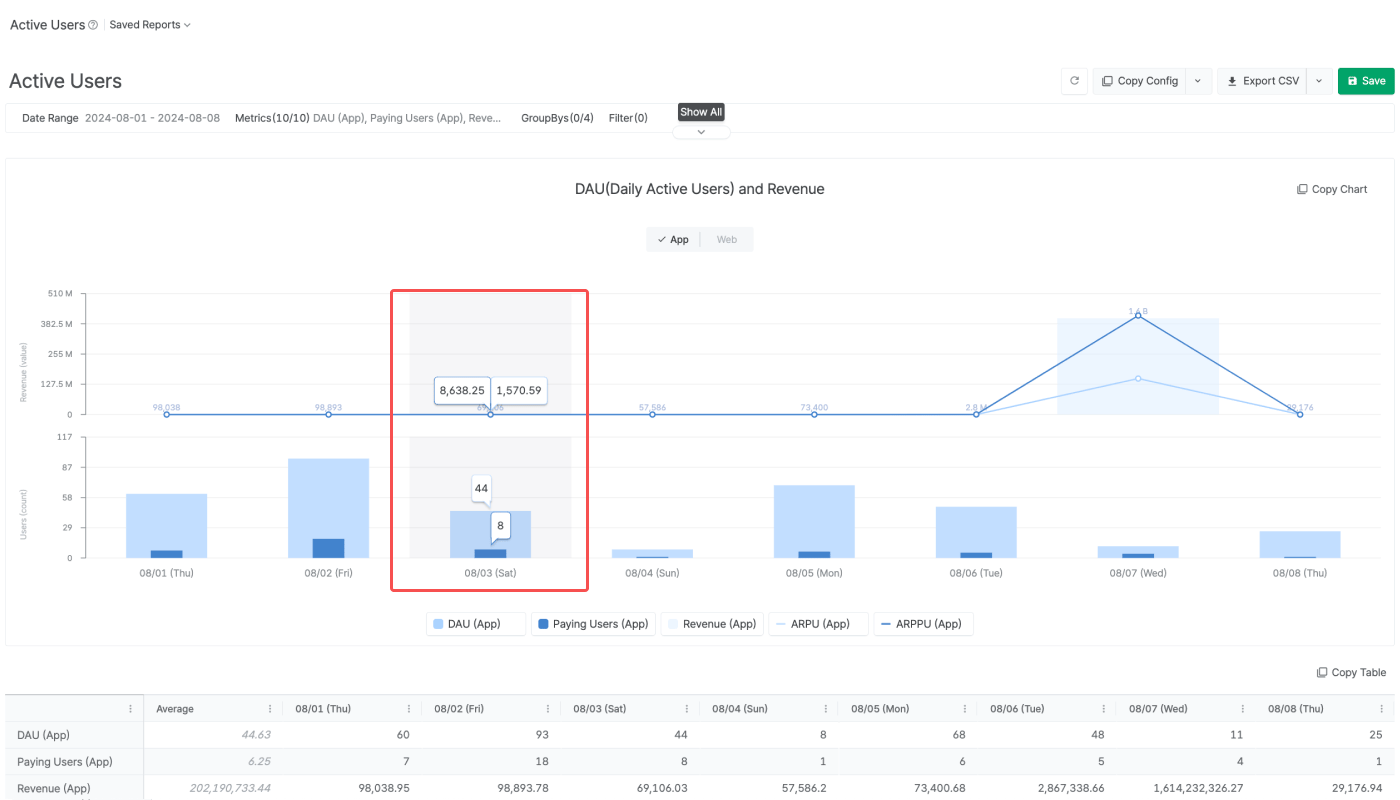
App or Web to view only 1 type of data. Click the metric items to hide or show specific items. The scale will be automatically adjusted when adding or removing certain metrics.
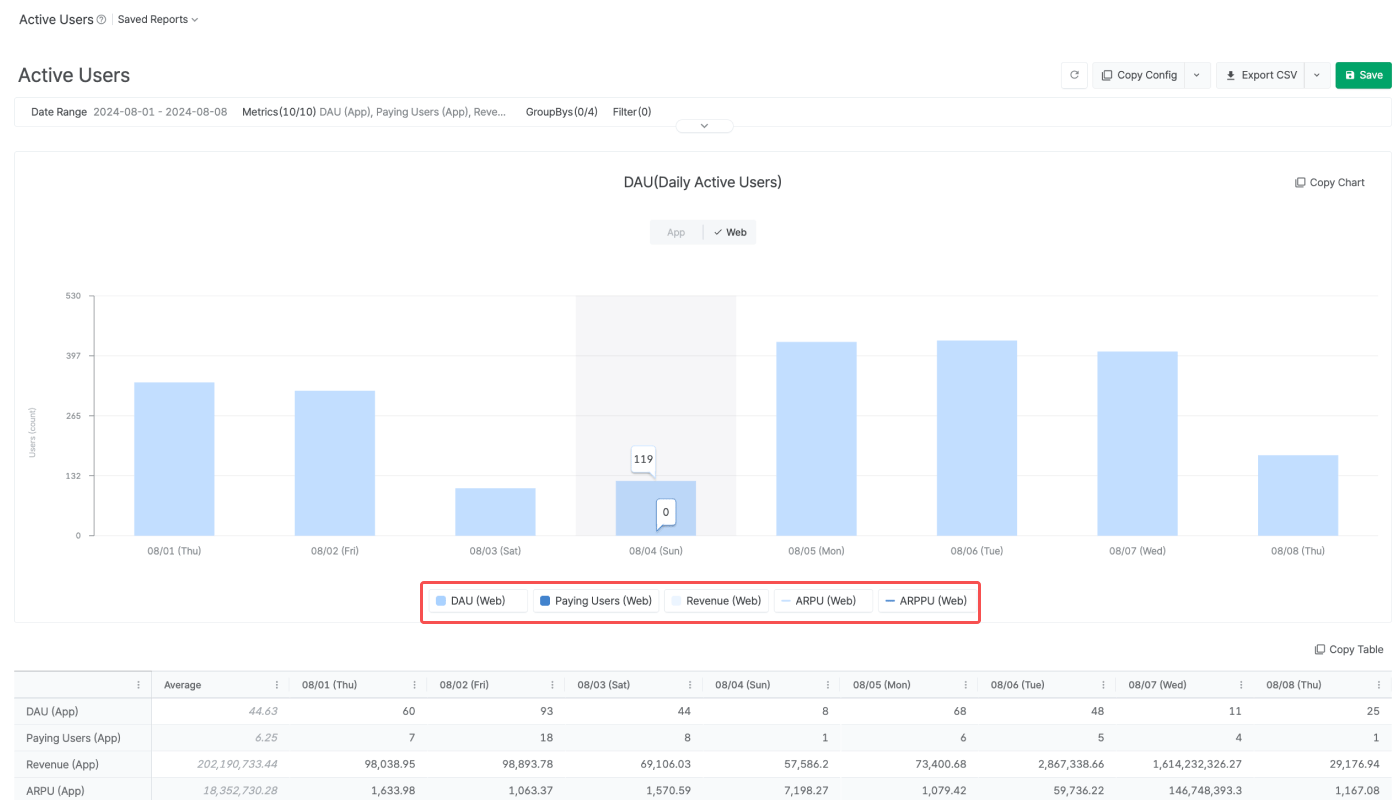
Table
The table shows the metric data by the set granularity. Both App data and Web data are displayed. In the first column, the average figure of each metric is displayed.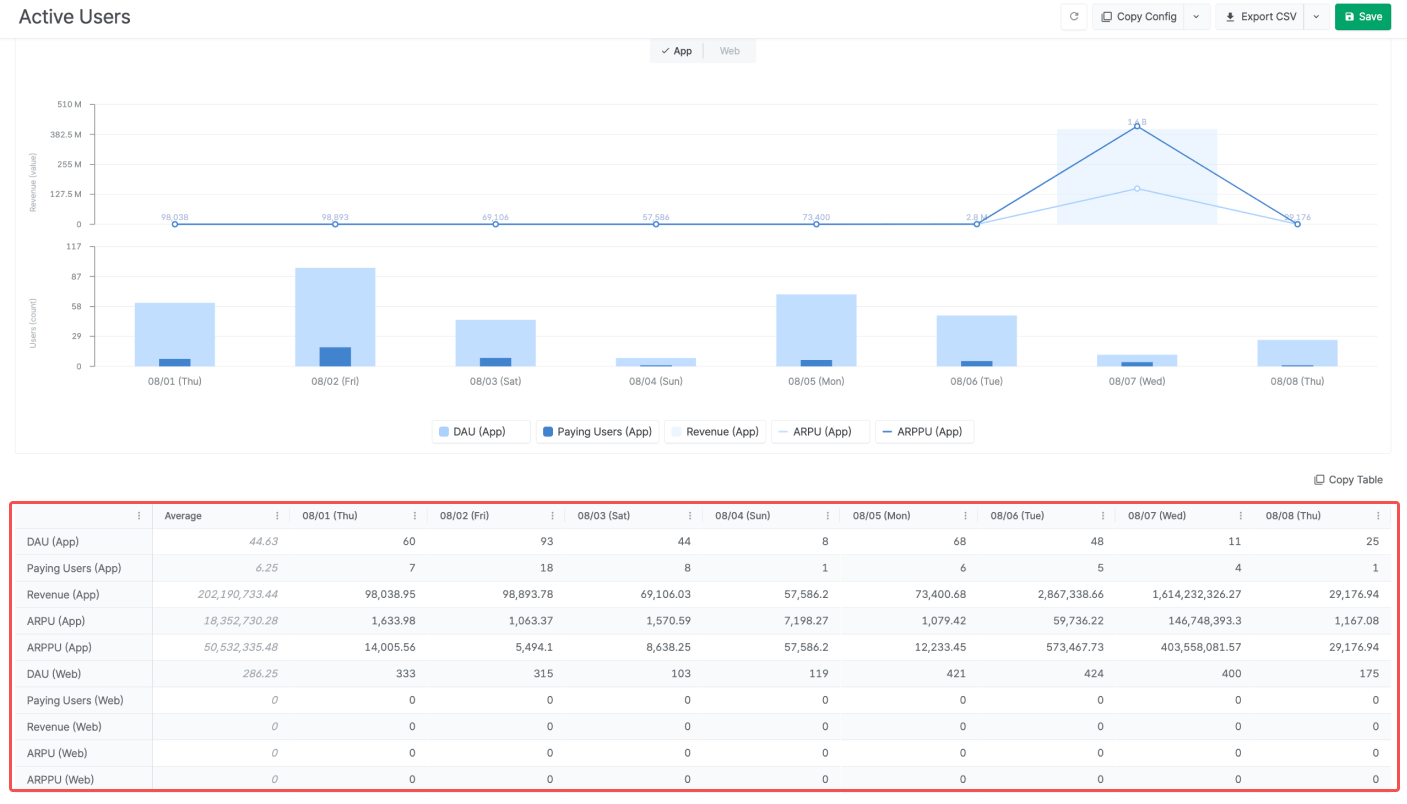
Supported features
Airbridge reports support various features, from saving reports to sharing them with others.General features
General features
The table shows the general features supported by Airbridge reports. Some features are not available in certain reports.
Attention
Supported features and limitations of the Active Users Report
Supported features and limitations of the Active Users Report
The table below outlines the features and limitations of the Active Users Report.