
NoteThis guide is for media partners (ad channels). If you’re an Airbridge user who would like to integrate an ad channel you’re currently using with Airbridge, you can submit a request by navigating to [Integrations]>[Ad Channel Integration] and clicking Request integration in the top right corner.
Cannot access the Integration Request for Media Partners form online?In case you are unable to access the form online, click the link below to download the PDF version. After filling out the form, submit it to integration@airbridge.io.
Basic Information
Enter the required details and click Next.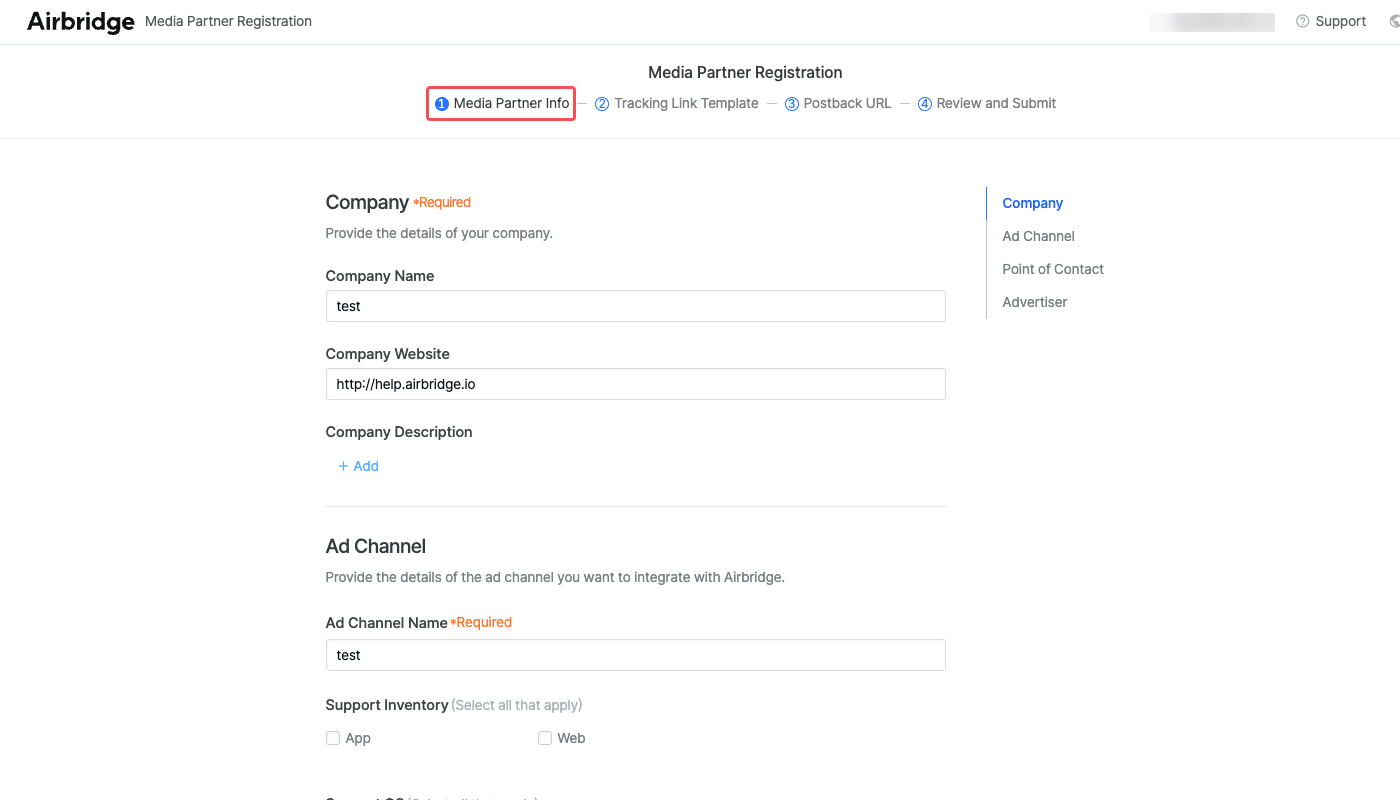
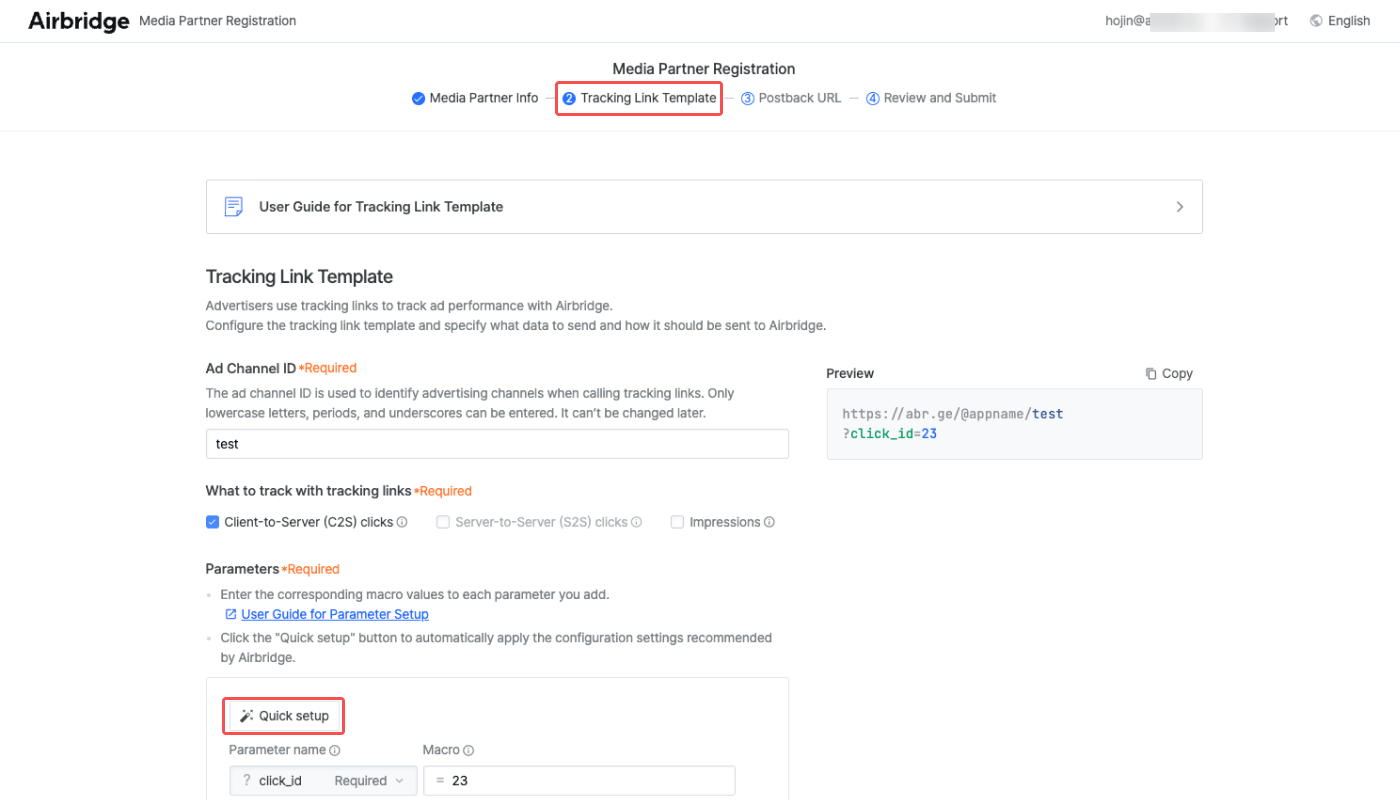
Tracking Link Template
Configure the tracking link template for Integrated Channel tracking links.Ad Channel ID
AttentionThe Ad Channel ID cannot be changed afterward.
What to track with tracking links
Multiple options can be selected. However, note that only 1 option between Click or S2S Click can be selected.Parameters
Configure the parameters for the tracking links. Click + Add to add parameters and enter the corresponding macro values used by the ad channel. Airbridge supports the following parametersChannel Parameters
Channel Parameters
Campaign (Custom) parameters contain detailed information about ad channels.
Campaign Parameters
Campaign Parameters
Campaign parameters contain detailed information about ad campaigns.
Airbridge Parameters
Airbridge Parameters
Airbridge parameters store information to enable Airbridge tracking link capabilities, such as touchpoint collection, user redirection, and deep linking.The following parameters are managed by Airbridge and are not available in the Media Partner Registration Form.
Custom parameter
Custom parameter
You can add custom parameters if necessary. The data sent using the custom parameter is only used as postbacks and cannot be viewed in the Airbridge reports.Follow the steps below to add a custom parameter.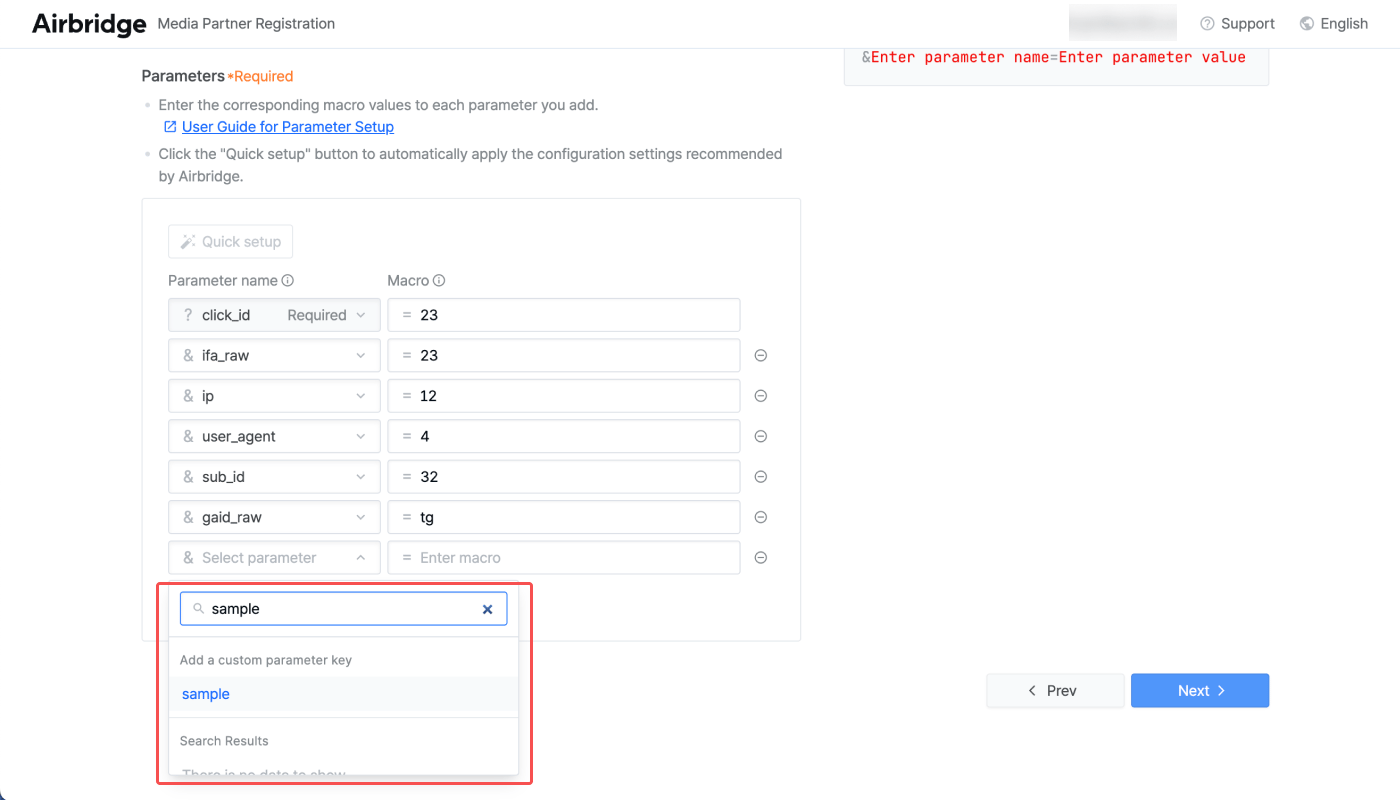
- Click Add.
- Enter the custom parameter name and click the name.
- Enter the macro value.
Postback URL
Airbridge sends the events and attribution data to the ad channel using a postback URL. Choose a data transmission method and configure the appropriate postback URL for each method.How the postback URL works
Airbridge sends the ad performance data to the postback URLs of the integrated ad channels after attributing the conversions following the Airbridge attribution model.Example: Postback URL
Example: Postback URL
The postback URL consists of macros.
https://api.example-ad-channel.com/postback/airbridge?touchpoint_id={attributionResult.attributedClickID}&ad_channel={attributionResult.attributedChannel}&event_timestamp={eventTimestamp}&customID={@trackingLink.custom_param}
{attributionResult.attributedClickID},{attributionResult.attributedChannel}, {eventTimestamp}, {@trackingLink.custom_param}.https://api.example-ad-channel.com/postback/airbridge?touchpoint_id=e7580180-7f04-11e6-bdf4-0800200c9a66&ad_channel=sample_channel&event_timestamp=1479186394000&customID=4093721
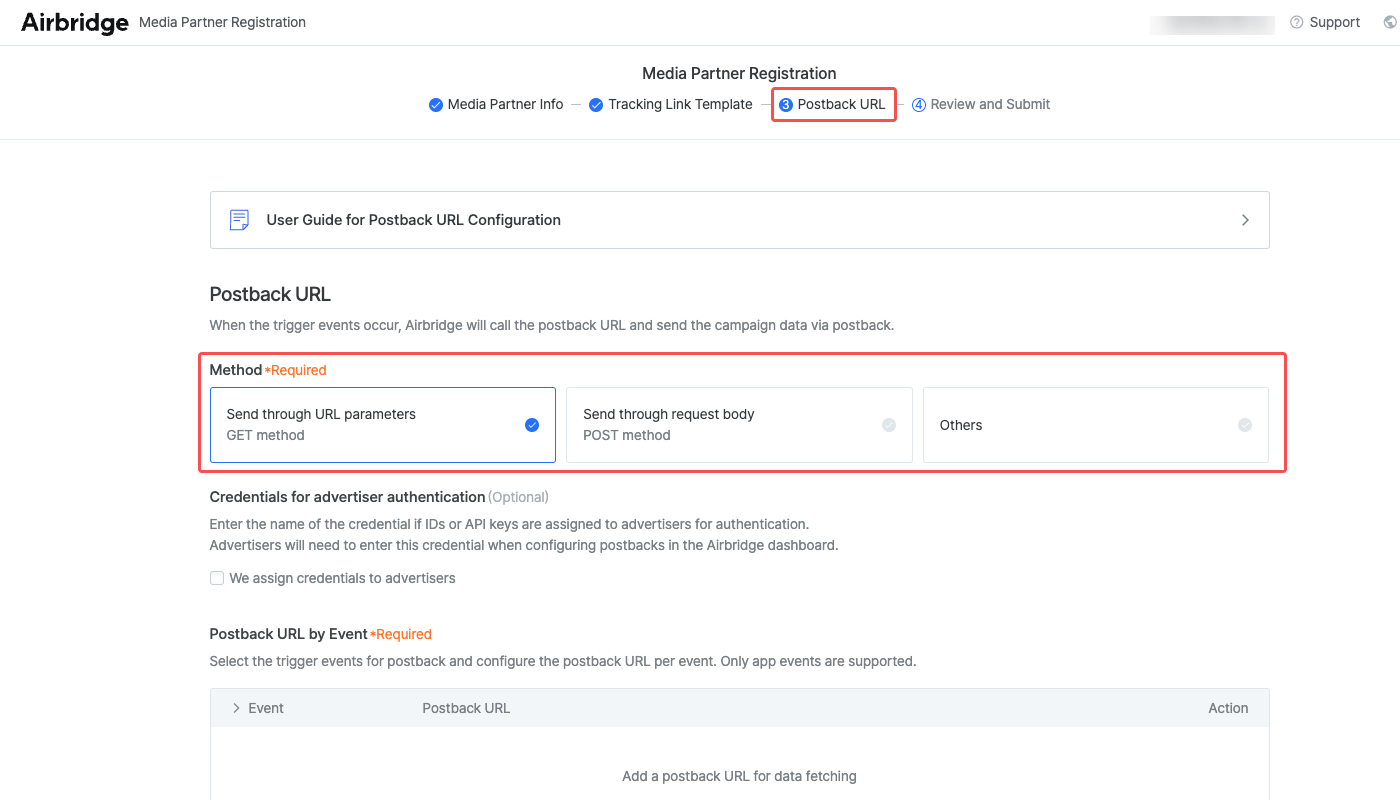
Data transmission method
Choose a data transmission method.- Send through URL parameters (Get method): Recommended method. Configuring the postback URLs by event is required.
- Send through request body (Post method): Requires additional coordination.
- Other methods: Requires additional coordination.
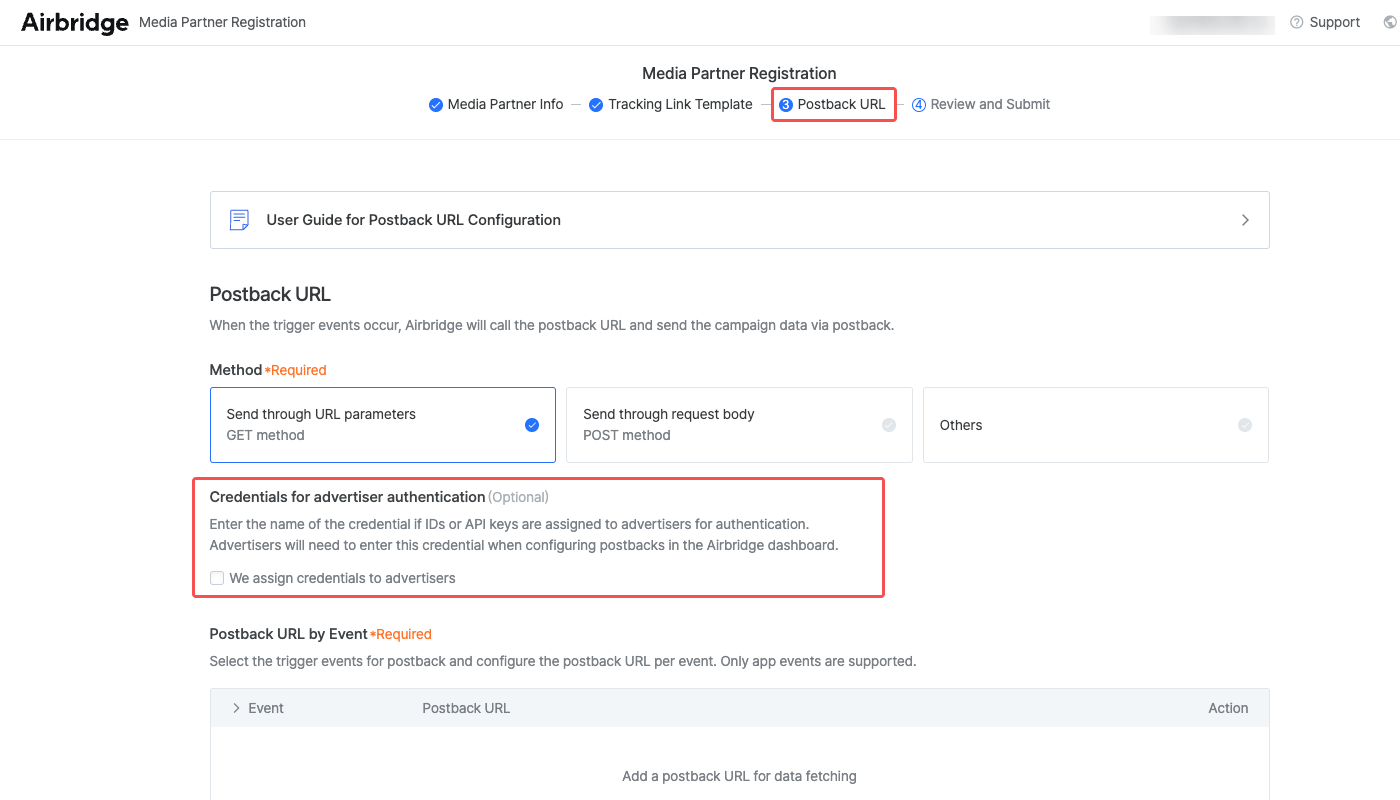
Configuring postback URLs by event
When choosing Send through URL parameters as the data transmission method, you need to configure the postback URLs by event. The postback URL for installs must be added to proceed.Adding postback URLs
Adding postback URLs
To configure a postback URL for an event, click Add postback URL to open a side panel.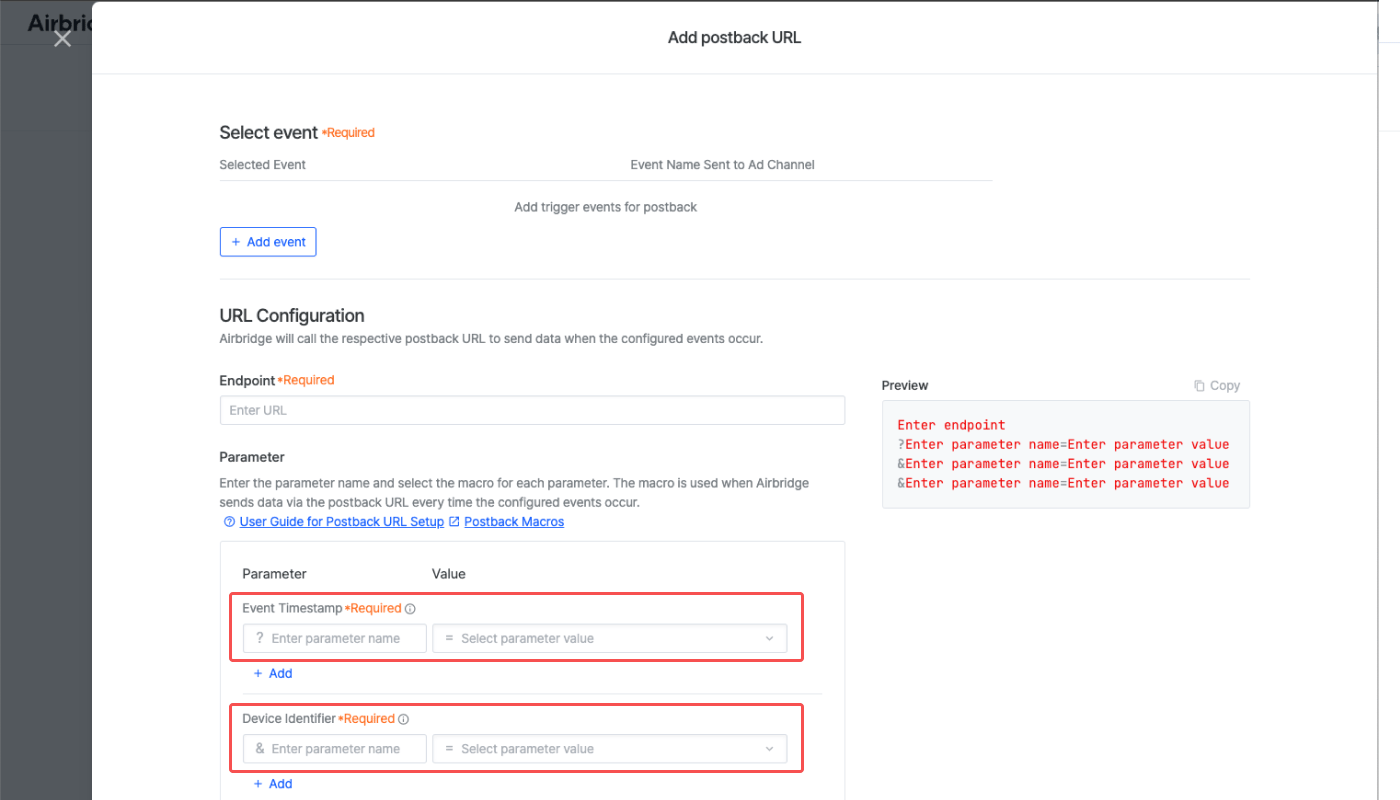
- In the side panel, Click Add event and select a Standard Event. Multiple events can be selected. When selecting multiple events, those events will be sent through the same parameter.
- Enter the endpoint. Enter the URL without the parameters.
- Configure the parameters. Enter the parameter name used by the ad channel and select the corresponding macro.
- Review the postback URL preview on the right and click Add if everything is in order.
Editing the postback URLs
Editing the postback URLs
Click a postback URL or click Action to edit the configuration or delete the postback URL.The postback URL for installs cannot be deleted.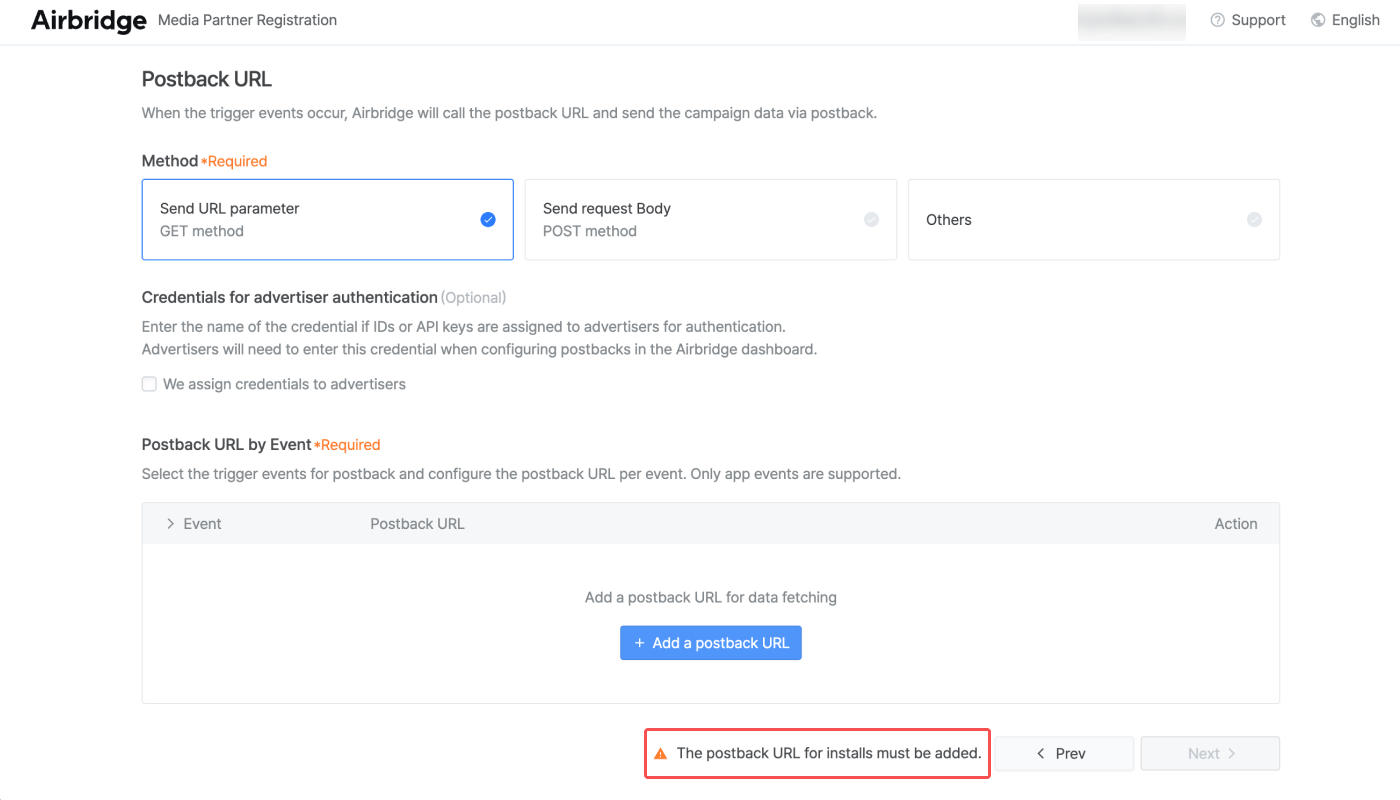
NoteThe Order Cancel event (airbridge.ecommerce.order.canceled) cannot be added to the postback URL.
List of Standard Events
List of Standard Events
The event category is the identifier used when forwarding events to ad channels or third-party platforms. Each destination displays it under its own mapped name.
Review and Submit
Once you have completed the integration request form, click Submit. After reviewing the information, the Airbridge integration team (integration@airbridge.io) will contact you within 5 business days. Additional coordination and testing for postbacks will follow.Attention
Configuring the tracking link template
Difference between S2S click and click
Difference between S2S click and click
When selecting S2S click, the ad channel redirects the users who click the ad. The Airbridge server is not involved in the data collection, and therefore, the ad channel must send the click data to Airbridge.Refer to the table below.
Postback URL
Required event in the postback URL
Required event in the postback URL
The app install event must be included in the postback URL. The integration with Airbridge is not possible if the app install event is absent in the postback URL.
Essential parameters in the postback URL by event
Essential parameters in the postback URL by event
The parameters for event occurrence time and device ID must be configured when adding events to the postback URL.
Event Timestamp
Device Identifier
The {device.deviceUUID} parameter or {device.gaid} and {device.ifa} parameters must be configured.When adding the {device.deviceUUID} parameter, 4 different types of device IDs can be collected. Therefore, it is recommended to configure the {device.DeviceUUIDType} parameter as well.Refer to this article for more details about device IDs.Adding postback.jsonData
Adding postback.jsonData
The postback.jsonData can be added using the postback URL. The postback.jsonData is a postback URL that allows you to send multiple product data in JSON format. By adding postback.jsonData as Others, you can view a JSON format that allows you to input product ID, product quantity, product price, and product name in a loop format.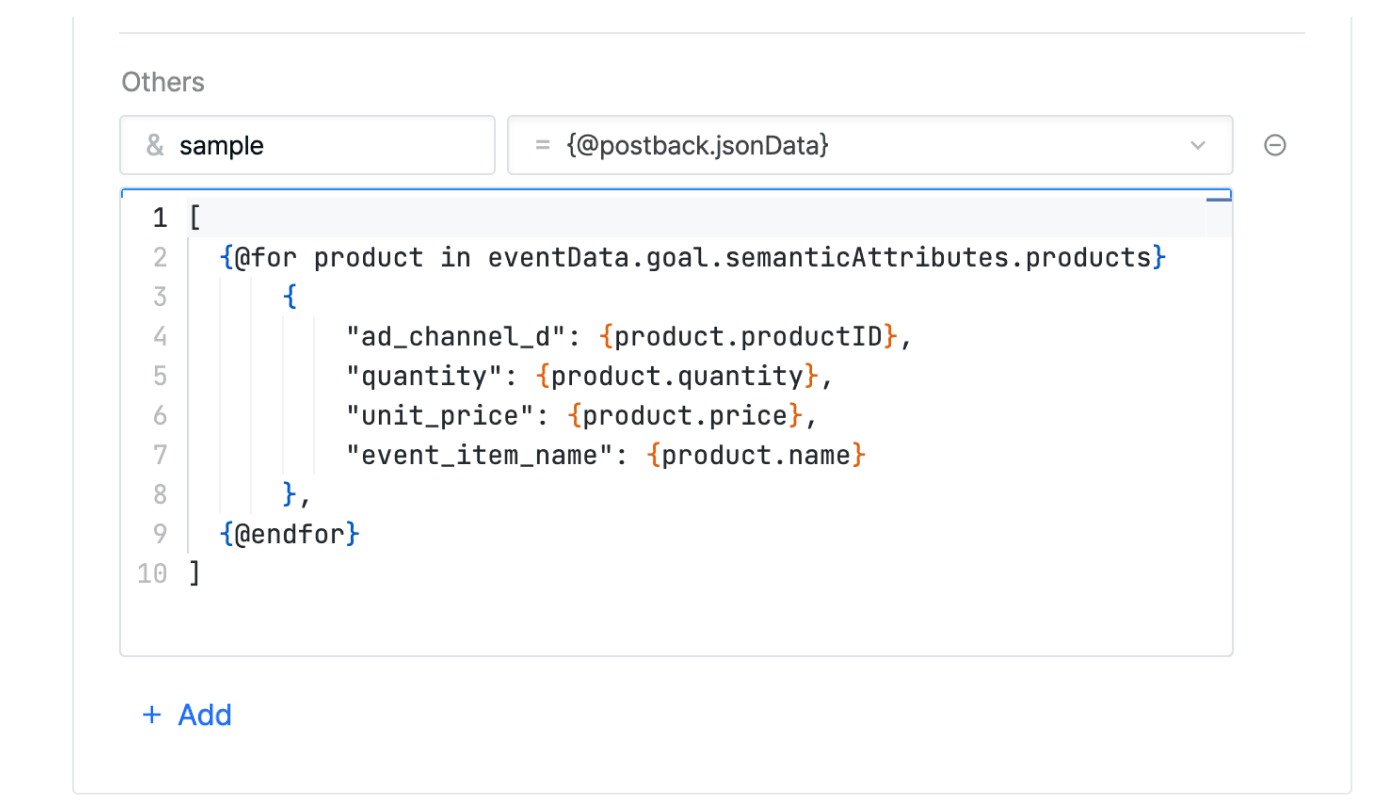
Web event postback
Web event postback
Since web event postbacks cannot be configured through the Integration Request for Media Partners form, contact our integration team (integration@airbridge.io). Before you do, here’s what you need to know:
- You can use your existing app event postback URLs for sending web events. Note that only parameters with a value of 1 in the Web column are provided in web event postbacks.
- To add parameters exclusively for web event postbacks, provide both the parameter name and value.
- Web event postbacks send all events regardless of whether they are first events or not. You cannot modify the First or All Events postback delivery rule.