
How EPC works
EPC protects the privacy of iOS users by removing attribution details from conversions on iOS 14.5 or later that were attributed through probabilistic matching, before Airbridge sends them to other services. Airbridge mainly uses probabilistic matching when a device ID is not available because the user has opted out of tracking via Apple’s App Tracking Transparency (ATT). As a result, most conversions that EPC applies to come from users who have not allowed tracking. If a user allowed tracking in both the app where they saw the ad and the app where the conversion occurred, the conversion is usually matched by device identifier, and EPC does not apply. EPC does not apply to conversions that occur on the web. However, EPC does apply to app conversions that were probabilistically attributed to a web touchpoint, such as a web ad click.EPC scope
Conversions that EPC applies to are recorded or sent as unattributed for the following:- Real-time logs
- Raw data exports
- Ad channel integrations
- Third-party integrations
- Cloud storage integrations
- Overview dashboard
- Airbridge reports
Configure EPC
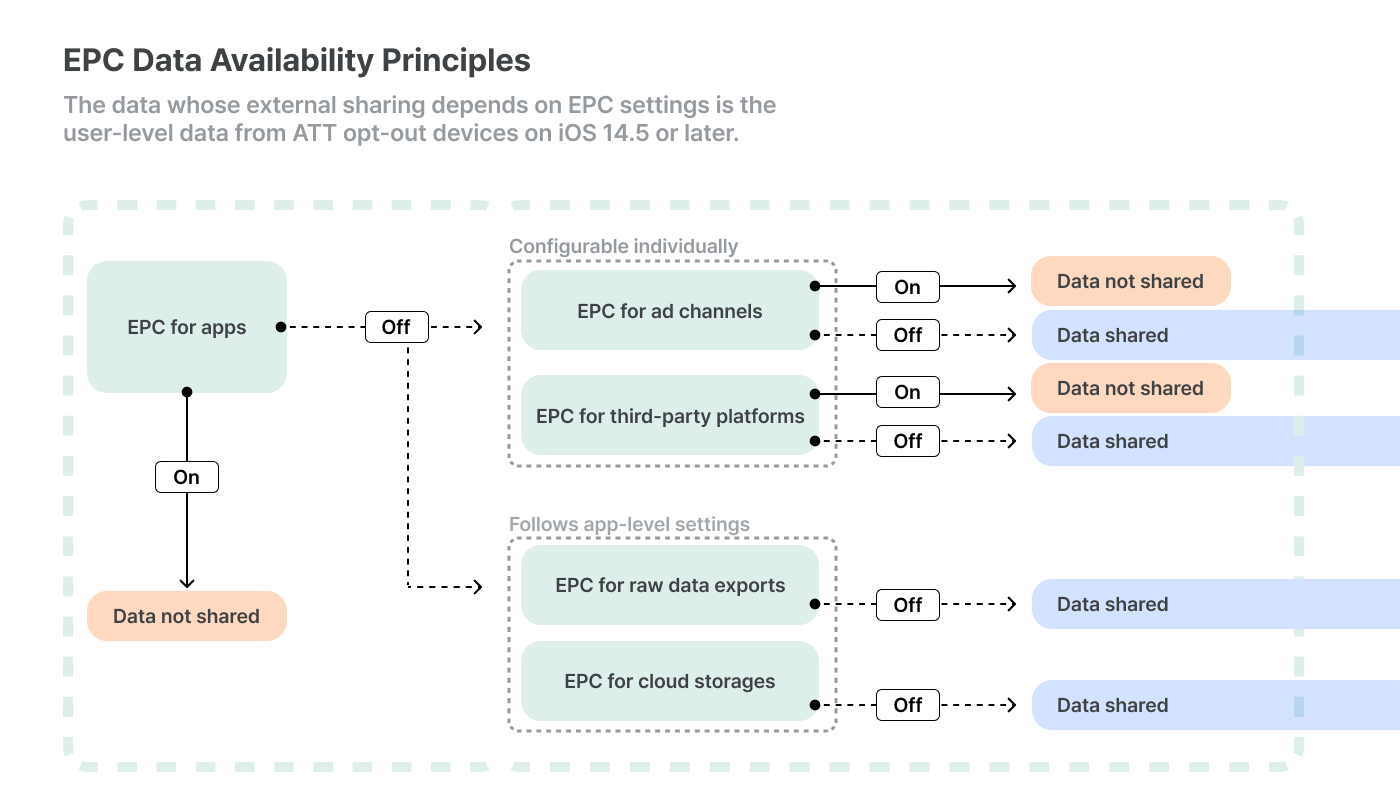
You can configure EPC at the app level and per integration. Each setting applies to the following:- App-level EPC: Ad channel integrations, third-party integrations, raw data exports, real-time logs, cloud storage integrations, and postbacks sent to your own server
- Per-integration EPC: Ad channel integrations and third-party integrations
EPC application rules
App-level EPC takes priority over per-integration EPC.- When app-level EPC is on, EPC applies to all ad channel and third-party integrations regardless of their per-integration EPC settings. Those settings are kept, but you cannot change them until app-level EPC is turned off.
- When app-level EPC is off, each integration follows its per-integration EPC setting.
NoteChanges to EPC settings can take up to 10 minutes to take effect.
EPC for integrations without a per-integration setting
For integrations without a per-integration EPC setting, including integrations you add later, whether EPC applies depends on whether app-level EPC has been turned on or off since October 16, 2026. Integrations with a per-integration EPC setting follow that setting while app-level EPC is off.
If app-level EPC has not been turned on or off since October 16, 2026, use one of the following methods to stop EPC from applying to integrations without a per-integration EPC setting.
Configure app-level EPC
In the Airbridge dashboard, go to [Settings]>[App Settings] and use the Apply App-Level EPC toggle at the bottom of the page to turn app-level EPC on or off. You can also change app-level EPC on the EPC (Extended Privacy Control) card in the [Data Out] section of [Integration]>[Integration Overview].While app-level EPC is on
While app-level EPC is on
Conversions that EPC applies to are processed as unattributed in the following:
- Real-time logs
- Raw data exports
- Ad channel integrations: Sent as unattributed in postbacks
- Third-party integrations
- Cloud storage integrations
unattributed.EPC applies to all ad channel and third-party integrations, including integrations you add later, regardless of their per-integration EPC settings, which you cannot change until you turn app-level EPC off.Regardless of EPC settings, you can view aggregated iOS campaign performance in the following:- Overview dashboard
- Airbridge reports
When you turn off app-level EPC
When you turn off app-level EPC
Raw data exports, real-time logs, and cloud storage integrations show attribution details for probabilistically matched iOS conversions.EPC applies only to integrations where you turned on per-integration EPC. All other ad channel and third-party integrations, including integrations you add later, receive probabilistically matched iOS conversions with attribution details.
NoteBefore you turn off app-level EPC, review Apple’s User Privacy and Data Use policy. If needed, consult legal counsel.
Configure per-integration EPC
When app-level EPC is off, you can configure per-integration EPC in the following places:- Ad channel integrations: [Postback] tab on each integration’s page
- Third-party integrations: Each integration’s page
- Meta Ads and Kakao Moment Conversions API integrations: [Conversions API] tab on each integration’s page
When you turn on per-integration EPC
When you turn on per-integration EPC
- Probabilistically matched iOS conversions are sent to the integration as unattributed. However, they are not sent to integrations that don’t accept unattributed conversions.
- Raw data exports, real-time logs, cloud storage integrations, and Airbridge reports are not affected.
- Per-integration EPC that you turn on stays on, even when you turn app-level EPC on or off.
When you turn off per-integration EPC
When you turn off per-integration EPC
- Probabilistically matched iOS conversions are sent to the integration with attribution details.
- If you turn on app-level EPC, EPC applies to the integration again.