
Designing an Event Taxonomy
The first step to designing an event taxonomy is to identify the data most relevant to your reporting, analytics, and decision-making. After determining the user actions and conversions to track, define the events to track with Airbridge.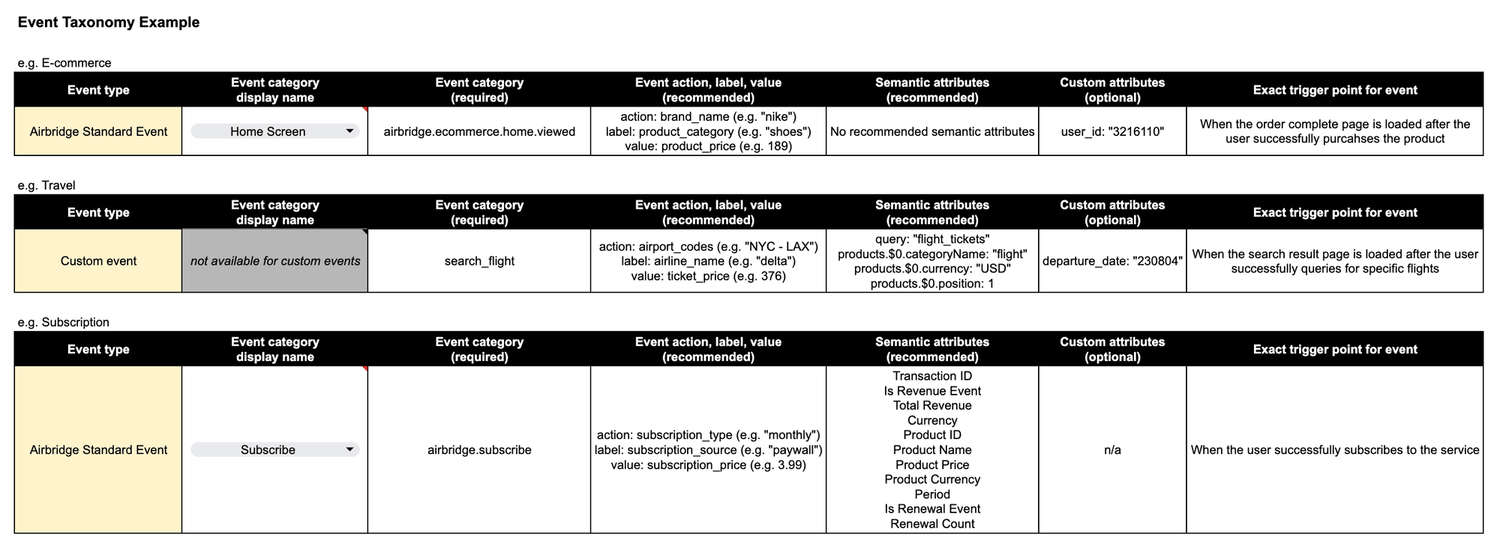
AttentionYou have the flexibility to redefine events at any time. However, note that the changes won’t apply to the data collected earlier, leading to potential data discrepancies. Make sure to consult closely with your Airbridge CSM during the initial event taxonomy design process.
Event Taxonomy Examples
- Sign-ups
- Subscriptions
- Reservations
- User engagement
Let’s say you are using the Standard Event for tracking sign-ups. The Event Category is predefined by Airbridge as
airbridge.user.signup and the other properties are not configured. You can view the data collected by selecting the “Sign-up” metric in Airbridge reports.Note that the Event Category should always be configured, whereas the other properties may be configured selectively depending on the nature of your business.NoteIt is advised to use the same definition for events or metrics with the same name across all Apps in your organization. Using consistent names and definitions within the organization can enhance efficiency in analyzing ad performance reports across multiple Apps.
Attention
How Trigger affects data collection
How Trigger affects data collection
Different data could be collected depending on how the Trigger is configured.For instance, if you configure to collect the “Order Complete” event when the user clicks the “Buy Now” button, the event will be collected even when the payment fails.However, if you configure to collect the “Order Complete” event when the order confirmation page is shown to the user, the event will be collected only when the payment is successful, and therefore, the event count will be more accurate.
Event count in Airbridge
Event count in Airbridge
Airbridge provides visibility into whether an event took place for the first time at the device and user levels.Airbridge also tracks the event count for all events, but the information is not available on the user level. For instance, if 3 users perform 7 “Order Complete” events, you will see 7 “Order Complete” events in your Airbridge report, but you won’t see how many events each user performed.
Naming rules for event properties
Naming rules for event properties
The names of the various event properties appear in the Airbridge dashboard exactly as you configured. It is recommended that you use letters in mixed case, numbers, and underscores.For more details on the naming rules, refer to this article.